Practical
Lauterbrunnen to Jungfraujoch Train: Routes, Times and Tickets
There is no single train from Lauterbrunnen to the Jungfraujoch, but there is a simple two-train route. From Lauterbrunnen station you take the green-and-yellow Wengernalp Railway up through Wengen to Kleine Scheidegg, which takes 42 minutes, then change to the Jungfrau Railway for the final 35 minutes through the Eiger and Mönch to the Jungfraujoch, 3,454 metres above sea level. Jungfrau Railways, the operator of both lines, puts this classic route at about 90 minutes including transfer times; Lauterbrunnen Tourism allows rather more, about 1 hour 45 minutes for the whole journey including the change.
The alternative is to go back down the valley and round to Grindelwald Terminal, where the Eiger Express gondola reaches Eigergletscher in 15 minutes and connects with the same Jungfrau Railway. It is the faster route from Grindelwald, and many visitors go up one way and come down the other. Whichever you choose, book a seat on the Jungfrau Railway: a reservation costs CHF 10 and is mandatory from 1 May to 31 October 2026.
For reaching Lauterbrunnen itself, see our guide to getting to Lauterbrunnen.
The short answer
- Classic route: Lauterbrunnen to Kleine Scheidegg on the Wengernalp Railway (42 minutes), then the Jungfrau Railway to the Jungfraujoch (35 minutes). About 90 minutes in total with the change.
- Fast route: by train to Grindelwald Terminal, the Eiger Express to Eigergletscher (15 minutes), then the Jungfrau Railway. The operator gives 45 minutes from Grindelwald Terminal to the top, or about 50 minutes including the transfer.
- Seat reservation: CHF 10 per person, mandatory from 1 May to 31 October 2026.
- At the top: the station, the Sphinx observation deck at 3,571 m, the Ice Palace and the glacier plateau.
- Allow: a whole day. Jungfrau Railways describes the trip as a day trip and recommends reserving the whole day for it.
Route one: Lauterbrunnen, Wengen and Kleine Scheidegg
This is the traditional way up, and it starts at the station you arrive at.
Lauterbrunnen to Kleine Scheidegg
The Wengernalp Railway leaves from Lauterbrunnen station and climbs the eastern side of the valley. The trip to Wengen takes 12 minutes, and the train continues above the car-free village to Kleine Scheidegg, 42 minutes from Lauterbrunnen. The line opened in 1893, and at 19,114 metres Jungfrau Railways calls it the longest cog railway in the world. It is also Wengen’s lifeline: the same railway supplies the car-free village with its goods.
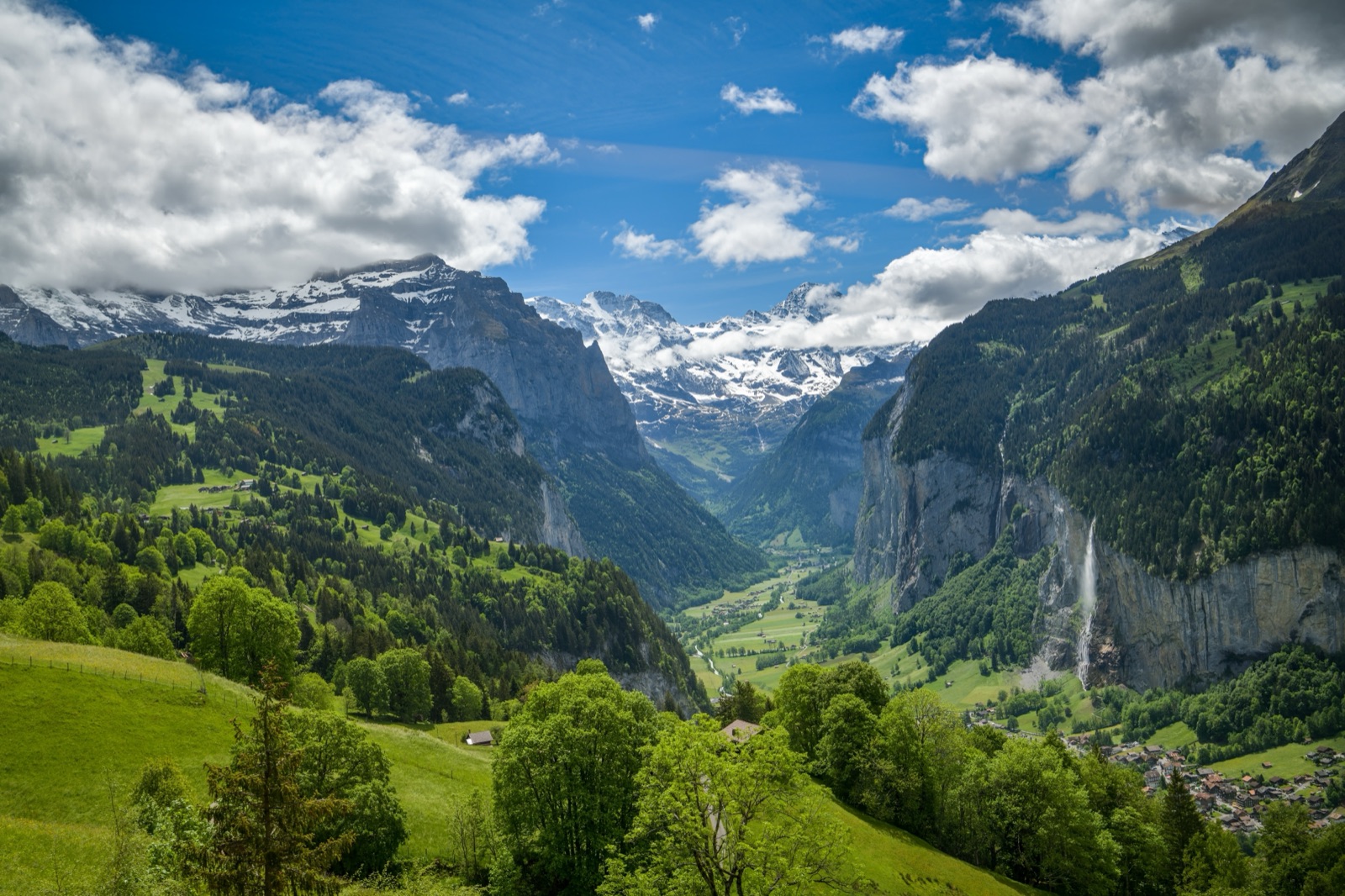
Above Wengen the views open out towards the Eiger, Mönch and Jungfrau; the operator describes this route as the more leisurely one, with a variety of views of the Jungfrau massif.
Changing at Kleine Scheidegg
Kleine Scheidegg, at 2,061 m, is a pass where two cogwheel railways meet: the Wengernalp Railway, arriving from Wengen on one side and Grindelwald on the other, and the Jungfrau Railway, which you change to here.
The change is organised with turnstiles and colour markings. Blue is for passengers with a seat reservation, yellow for those without, who board once the reserved passengers are on and only if there are seats left. Pass the turnstiles towards the Jungfraujoch at least 10 minutes before your train departs.
The Jungfrau Railway
The Jungfrau Railway opened in 1912 and is the famous part of the journey. Of its nine-kilometre route, 7.6 kilometres run through a tunnel inside the Eiger and Mönch. From Kleine Scheidegg the train climbs 1,400 metres, and the trip takes 35 minutes.
Before entering the mountain, the train passes Eigergletscher, the station at the foot of the Eiger where the Eiger Express arrives. Inside the tunnel it stops at Eismeer, at around 3,160 m, for five minutes, so that passengers can look out through the viewing window at the glacier. The line itself is a piece of engineering history: ground was broken on 27 July 1896, and the Eigerwand station, in the middle of the Eiger north face at 2,865 m, opened on 28 June 1903. The section to the Jungfraujoch was not finished until 1912, nine years later than planned. The plan had been to carry on to the summit of the Jungfrau, but stretched finances and the death of the founder, Adolf Guyer-Zeller, changed it, and the Jungfraujoch became the end of the line.
Route two: back down the valley and up by the Eiger Express
The Eiger Express is a tricable gondola from Grindelwald Terminal to Eigergletscher, and it is the fastest way up.
Getting from Lauterbrunnen to Grindelwald Terminal
Lauterbrunnen and Grindelwald sit in neighbouring valleys, both served by the Bernese Oberland Railway from Interlaken Ost, and the two lines divide at Zweilütschinen. From Lauterbrunnen you therefore ride back down to Zweilütschinen and change for the Grindelwald branch, which stops at Grindelwald Terminal before the village; check the connection in the SBB timetable. Our article on Grindelwald from Lauterbrunnen covers the two valleys in more detail.
The Eiger Express
The Eiger Express was commissioned in December 2020. The gondola runs from Grindelwald Terminal to Eigergletscher (2,320 m) in 15 minutes, with what the operator calls the best view of the Eiger north face. At Eigergletscher you change to the Jungfrau Railway for the tunnel section to the top. Jungfrau Railways gives 45 minutes from Grindelwald Terminal to the Jungfraujoch, and about 50 minutes including transfer times. From Eigergletscher there is a train to the Jungfraujoch every 30 minutes, depending on season and demand.
This is also the route for anyone who needs step-free travel. The operator states that the fastest route, Interlaken Ost to Grindelwald Terminal, the Eiger Express, Eigergletscher and the Jungfraujoch, is barrier-free, while travelling via Kleine Scheidegg requires booking assistance in advance by telephone.
Up one way, down the other
You do not have to choose. Jungfrau Railways sells combined journeys: up on the Wengernalp Railway via Kleine Scheidegg and down on the Eiger Express to Grindelwald Terminal, or vice versa. From Lauterbrunnen the natural loop is up from your own station via Wengen, down by the Eiger Express, and back round on the Bernese Oberland Railway via Zweilütschinen, as in the sample day below. Reverse it if you would rather see the Eiger north face from the gondola on the way up.
Journey times at a glance
| Leg | Time given by the operator |
|---|---|
| Lauterbrunnen to Wengen | 12 minutes |
| Lauterbrunnen to Kleine Scheidegg | 42 minutes |
| Kleine Scheidegg to Jungfraujoch | 35 minutes |
| Lauterbrunnen or Grindelwald to Jungfraujoch, classic route | about 90 minutes including transfers |
| Grindelwald Terminal to Eigergletscher (Eiger Express) | 15 minutes |
| Grindelwald Terminal to Jungfraujoch | 45 minutes; about 50 including the transfer |
Timetables change with the season and demand, so check your exact connections in the SBB app or on the operator’s timetable before you go.
Seat reservations
For the Jungfrau Railway, the operator strongly recommends a paid seat reservation of CHF 10 per person, and from 1 May to 31 October 2026 it is mandatory. The reservation covers the Jungfrau Railway between Eigergletscher or Kleine Scheidegg and the top, and it gives you a timed slot. Without one, the operator warns, the train may well be full at peak times and you wait for the next one.
A few practical points from the operator’s own answers:
- Children also need the reservation in the mandatory period, at the same CHF 10.
- Online reservations can be rescheduled up to 45 minutes before the journey, but reservation costs are not refunded.
- Travelling without a reservation means expecting waits at Kleine Scheidegg, Eigergletscher or the Jungfraujoch.
Tickets, prices and passes
Jungfrau Railways advertises its return ticket to the Jungfraujoch from CHF 129.60. What you pay depends on where you start, the date and any pass you hold; the operator’s online price calculator shows the exact fare, including pass discounts. Prices here were taken from the operator’s pages in September 2026, so check before you go.
Passes that change the price
- Half Fare Travelcard and Swiss Half Fare Card: valid on the whole Jungfrau Railways network, which makes the Swiss Half Fare Card worth pricing up if you plan several mountain trips.
- Swiss Travel Pass: on a valid travel day it covers the trains to Wengen, Mürren and Grindelwald, and gives discounts on the mountain railways and cableways above them. Swiss Travel System, which issues the pass, advertises 25% off the Jungfraujoch. If you have a Flex pass, the travel day must be validated to get the reduction.
- Jungfrau Travel Pass: unlimited travel in the region for three to eight days, with 3 days costing CHF 210 for adults, CHF 165 reduced and CHF 30 for children. It does not include the Jungfraujoch itself, but holders buy a connecting ticket from CHF 63, or CHF 89 from 1 May to 31 October 2026.
- Good Morning Ticket: a discounted fare for the early trains, offered from 1 May to 31 October 2026. The operator’s own pages quote the discount differently, so check the rate at the moment you book.
Children
Children up to 5 travel free. Children aged 6 to 15 travel free with the Junior Card or the Children’s Travelpass, or otherwise pay CHF 20, plus the seat reservation in the mandatory period.
What there is at the top
The Jungfraujoch station is the highest railway station in Europe, and the complex around it is open 365 days a year. Jungfrau Railways says it welcomes over one million visitors each year, so expect company.
- The Sphinx observation deck (3,571 m). A lift inside the rock takes you up to the terrace beside the research observatory. From here you look down the Aletsch Glacier, the longest glacier in the Alps: 22 km long, 900 m thick and 12 billion tonnes of ice. The area is part of the Swiss Alps Jungfrau-Aletsch World Heritage site.
- The glacier plateau. Outdoors on the snow, where the operator guarantees snow and ice 365 days a year. On a clear day the view runs as far as the Black Forest and the Vosges on one side and along the Aletsch Glacier on the other.
- The Ice Palace. Halls and passages cut into the glacier and lined with ice sculptures; the operator calls it the largest ice palace in the Alps.
- Alpine Sensation. A multimedia walk through over 100 years of the railway’s history.
- Snow Fun Park. Snow activities on the glacier, open 4 May to 18 October 2026.
- The Mönchsjoch hut hike. A glacier walk possible from mid-March to mid-October; allow extra time to get back to the station for your train.
- Food and shops. Four restaurants and two bars, and what the operator calls the highest Lindt shop in the world.
The altitude: what to expect
Lauterbrunnen is on the valley floor; the Jungfraujoch is at 3,454 metres, and the Sphinx at 3,571. That is a big climb for a single morning.
Jungfrau Railways explains the basics plainly. The higher you go, the lower the air pressure, and the less oxygen your body takes in. For a healthy person this is usually harmless, but acute altitude sickness can develop from 2,500 metres, and if it does you need to go down quickly. The operator’s advice is to make the trip only if you are in good health.
The NHS gives similar thresholds. It says altitude sickness is a risk usually above 2,500 metres and is more likely if you go up quickly, which is exactly what a train to the Jungfraujoch does. It also advises trying not to travel from below 1,200 metres to above 3,500 metres in 1 day, a line the Sphinx terrace just crosses. Its symptoms usually start 6 to 10 hours after arrival and include headache, feeling sick, tiredness and dizziness; if they get worse, the NHS says to go around 300 to 1,000 metres lower. It also suggests talking to a GP or travel clinic if you have had altitude sickness before or are going high quickly.
Jungfrau Railways lists who should get medical advice first, and who should not go:
- Consult a doctor first if you have a marked cardiovascular risk profile: smoking, high blood pressure, diabetes, high blood lipids, obesity or occasional chest pain.
- Do not go if you have heart or lung disease that leaves you short of breath on the stairs, if you have recently had a stroke, or if you have a cold or fever.
- Pregnancy: the operator advises against it from the 7th month or in a high-risk pregnancy.
- Babies: children under 2 often cannot equalise pressure properly.
On the day, walk slowly, especially on stairs, drink water, and if you feel unwell, tell someone and head back down.
Weather, clothing and choosing your day
Jungfrau Railways makes a point worth remembering: even when it is cloudy in the valley, at 3,454 metres and above the clouds can often only be seen from above. A grey morning in Lauterbrunnen does not always mean a grey Jungfraujoch; check the operator’s webcam before you decide.
It is always cold at the top. The operator expects temperatures below freezing in summer and winter, with weather that can change at short notice. Dress in layers and bring a jacket, closed shoes, a hat, gloves and sunglasses. The sun on the glacier is strong, and the operator warns of a considerable risk of snow blindness without sunglasses, even in poor weather.
MeteoSwiss’s averages for the Jungfraujoch, month by month, are in our article on Lauterbrunnen weather: even in July the average daily high there is only a few degrees above freezing.
How long to allow
Jungfrau Railways’ planning figures start in Grindelwald but are a useful guide:
- Via the Wengernalp Railway: 1 hour 26 minutes each way from Grindelwald, with at least 5 to 6 hours recommended in total.
- Via the Eiger Express: 45 minutes each way from Grindelwald Terminal, with at least 3.5 to 4.5 hours recommended.
The classic route from Lauterbrunnen takes about as long as the one from Grindelwald, so plan on most of a day.
A sample day from Lauterbrunnen
- Early morning: the Wengernalp Railway from Lauterbrunnen through Wengen to Kleine Scheidegg (42 minutes).
- Mid-morning: the Jungfrau Railway to the top (35 minutes), with the five-minute stop at Eismeer.
- Late morning: the Sphinx terrace, the Ice Palace and the plateau, taking the stairs slowly.
- Lunch: at one of the restaurants at the top.
- Afternoon: down to Eigergletscher and the Eiger Express to Grindelwald Terminal, or back the way you came.
- Late afternoon: the Bernese Oberland Railway to Zweilütschinen and on to Lauterbrunnen.
With a spare day, keep the Jungfraujoch for the clearest one; our guide to Mürren, Wengen and the Schilthorn covers the rest of the valley.
Tours and the Jungfraujoch
The guided coach days from Zurich and Lucerne that include Lauterbrunnen list Interlaken, Grindelwald and a walk in Lauterbrunnen village as their stops; the Jungfraujoch is not among them. If the Jungfraujoch is the point of your trip, travel independently by train, which is straightforward from Lauterbrunnen, or look at the full list of tours and tickets on our tours page.
Frequently asked questions
How long is the train from Lauterbrunnen to the Jungfraujoch?
About 90 minutes including the change, according to Jungfrau Railways; Lauterbrunnen Tourism gives about 1 hour 45 minutes. The Wengernalp Railway takes 42 minutes to Kleine Scheidegg, and the Jungfrau Railway 35 minutes from there to the top.
Do I need to change trains?
Yes. On the classic route you change at Kleine Scheidegg from the Wengernalp Railway to the Jungfrau Railway. On the Eiger Express route you change at Zweilütschinen for Grindelwald, at Grindelwald Terminal for the gondola, and at Eigergletscher for the train.
Is a seat reservation required?
From 1 May to 31 October 2026, yes: it is mandatory and costs CHF 10 per person, children included. Outside that period the operator still strongly recommends one, because without it the train may be full at busy times.
Is the Jungfraujoch covered by the Swiss Travel Pass?
Not in full. The pass covers the trains to Wengen and Grindelwald, and Swiss Travel System advertises 25% off the Jungfraujoch itself. The Half Fare Card is valid on the whole Jungfrau Railways network.
Which is better from Lauterbrunnen, Kleine Scheidegg or the Eiger Express?
Kleine Scheidegg is the direct route from Lauterbrunnen and the more scenic climb. The Eiger Express is faster from Grindelwald Terminal but means first riding round via Zweilütschinen. Many visitors go up one way and down the other.
Will I feel the altitude?
Possibly. The Jungfraujoch is at 3,454 metres, and both the operator and the NHS note that altitude sickness can start from about 2,500 metres. Take it slowly, drink water, and go down if you feel unwell; if you have heart or lung problems, ask your doctor first.