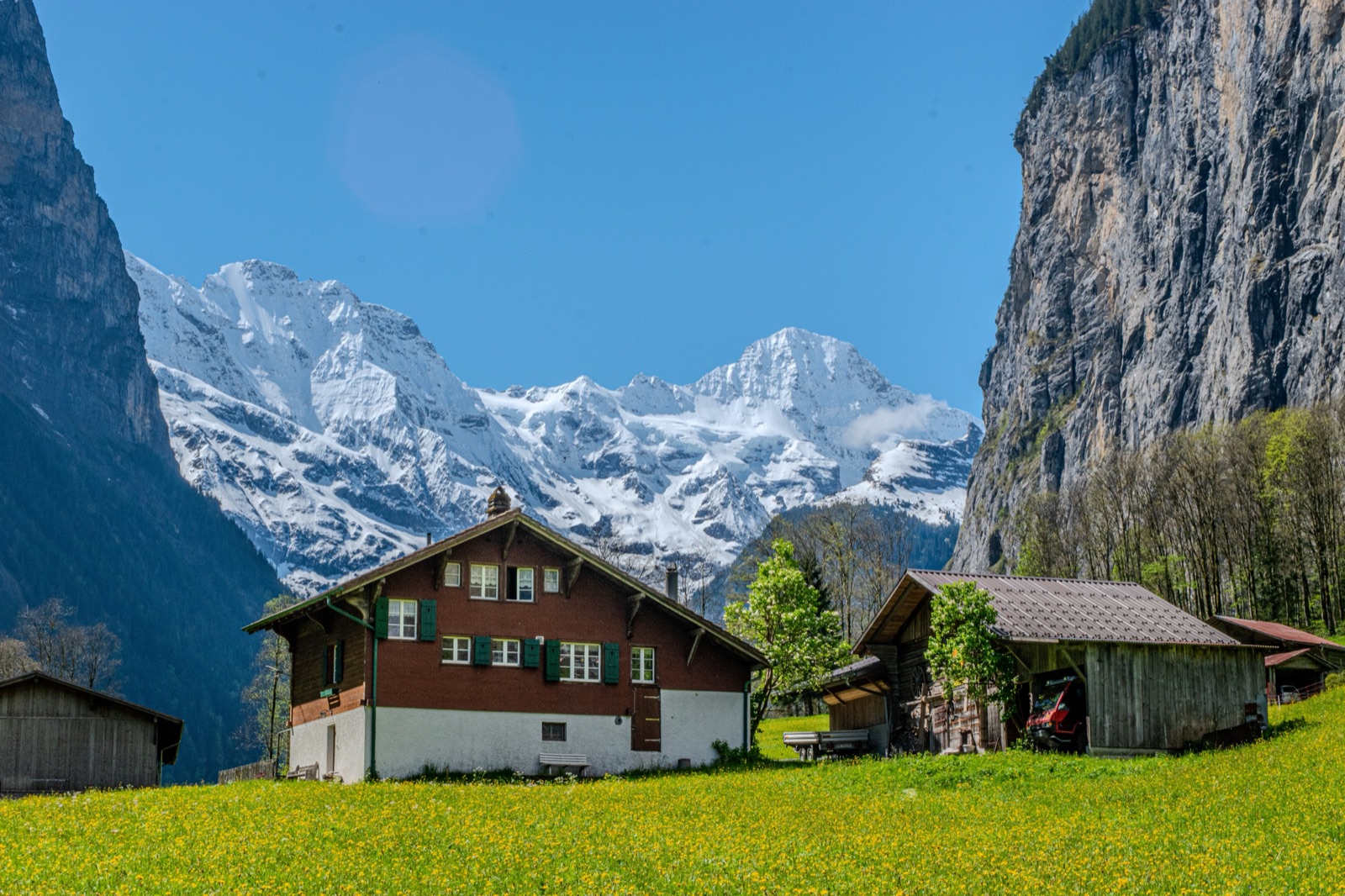
Reference
Lauterbrunnen Weather by Month: Rain, Temperature and Seasons
Lauterbrunnen weather this week
Lauterbrunnen (795 m)
The five-day forecast for Lauterbrunnen, updated through the day.
Forecast data from MET Norway (CC BY 4.0), summarised by day.
Lauterbrunnen has warm, fairly wet summers and cold, snowy winters. MeteoSwiss, the Swiss federal weather service, measures precipitation in Lauterbrunnen itself, at a station at 815 m: on its 1991–2020 averages the wettest month is July, with 149.4 mm, the driest is February, with 72.2 mm, and the year adds up to 1,202.9 mm. MeteoSwiss publishes no temperature averages for the village, so the nearest long-term guide is Interlaken (578 m), a short train ride down the valley, where July afternoons average 24.3 °C and January nights −2.8 °C. Lauterbrunnen sits higher, between steep cliffs, so expect it to be a little cooler than Interlaken.
For most visitors the choice comes down to what you want to see. Late spring and early summer bring meltwater, when the Staubbach falls are at their most powerful. High summer is the warmest and also the wettest time. September is noticeably drier than August, and late October and November are when several lifts close for their annual overhaul. Winter brings snow on the terraces, frost in the valley and short days on the valley floor.
This article sets out the numbers month by month, then explains what they mean in practice: the waterfalls, the cloud, the lifts and what to pack. Averages describe typical conditions, not a forecast; for the days of your trip, use MeteoSwiss’s local forecast for Lauterbrunnen.
The climate in brief
- Warmest month: July. Interlaken averages a daily maximum of 24.3 °C and a minimum of 13.8 °C.
- Coldest month: January. Interlaken averages 3.2 °C by day and −2.8 °C at night.
- Wettest month in Lauterbrunnen: July, 149.4 mm, followed closely by August, 146.1 mm.
- Driest month in Lauterbrunnen: February, 72.2 mm.
- Up on the terraces: Mürren, at 1,632 m, gets 1,536.2 mm a year, more than the valley floor.
- At the Jungfraujoch: even in August the average daily maximum is only 3.5 °C.
Month by month in the valley
The table combines two MeteoSwiss stations: temperatures from Interlaken, the closest station with long-term temperature averages, and precipitation from Lauterbrunnen itself. All figures are 1991–2020 averages.
| Month | Interlaken average high | Interlaken average low | Lauterbrunnen precipitation |
|---|---|---|---|
| January | 3.2 °C | −2.8 °C | 81.3 mm |
| February | 5.4 °C | −2.5 °C | 72.2 mm |
| March | 10.5 °C | 0.9 °C | 73.5 mm |
| April | 14.7 °C | 4.1 °C | 80.7 mm |
| May | 18.7 °C | 8.3 °C | 121.1 mm |
| June | 22.4 °C | 12.1 °C | 129.7 mm |
| July | 24.3 °C | 13.8 °C | 149.4 mm |
| August | 23.7 °C | 13.6 °C | 146.1 mm |
| September | 19.2 °C | 10.0 °C | 90.4 mm |
| October | 14.1 °C | 6.0 °C | 80.0 mm |
| November | 7.8 °C | 1.2 °C | 82.5 mm |
| December | 3.7 °C | −1.8 °C | 96.0 mm |
| Year | 14.0 °C | 5.2 °C | 1,202.9 mm |
Two things stand out. First, precipitation jumps in May (121.1 mm) and stays high through August, so the warm months are also the wet ones; summer in the valley means pleasant temperatures with a real chance of rain on any given day. Second, September (90.4 mm) falls back sharply while Interlaken still averages 19.2 °C by day, which makes it one of the most comfortable months for walking.
Higher up: Mürren, Kleine Scheidegg and the Jungfraujoch
The valley floor is only part of the picture. Many visitors also go up to the terraces or the high peaks, where the weather is wetter, colder or both.
| Month | Mürren precipitation | Jungfraujoch average high |
|---|---|---|
| January | 107.9 mm | −9.5 °C |
| February | 98.8 mm | −10.2 °C |
| March | 101.0 mm | −8.6 °C |
| April | 111.4 mm | −6.3 °C |
| May | 159.4 mm | −2.1 °C |
| June | 155.4 mm | 1.7 °C |
| July | 179.2 mm | 3.4 °C |
| August | 176.8 mm | 3.5 °C |
| September | 117.5 mm | 0.5 °C |
| October | 101.5 mm | −2.2 °C |
| November | 103.8 mm | −6.5 °C |
| December | 123.5 mm | −8.7 °C |
| Year | 1,536.2 mm | −3.8 °C |
Mürren, on the western terrace at 1,632 m, receives roughly a quarter more precipitation than Lauterbrunnen over a year, and Kleine Scheidegg, at 2,061 m on the way to the Jungfraujoch, more again: 1,645.4 mm, with 184.9 mm in July alone. In winter much of it falls as snow.
The Jungfraujoch station is a world apart. MeteoSwiss measures there at 3,571 m, and the average daily high stays below freezing from October to May, reaching only 3.4 °C in July. Jungfrau Railways, which runs the trains to the top, tells visitors to expect temperatures below freezing in summer and winter, and weather that can change at short notice. Our article on the train from Lauterbrunnen to the Jungfraujoch covers the trip itself.
Spring: meltwater and waking waterfalls
From March to May, the valley warms quickly: Interlaken’s average high climbs from 10.5 °C in March to 18.7 °C in May. Snow lingers much longer on the terraces and peaks, and as it melts, the waterfalls fill.
Lauterbrunnen Tourism says the Staubbach is at its most powerful in spring and early summer, when meltwater from the surrounding mountains feeds it. This is the season to see the valley of 72 waterfalls at full strength.
The Trümmelbach falls, inside the mountain, open in early April. Their own listing adds two warnings: the attraction closes temporarily every spring because of extreme seasonal weather, and the exact opening and closing dates depend on the weather. If a spring visit hinges on the Trümmelbach, check its status on the day.
Spring is also a changeover season for the lifts. For 2027, the Schilthorn operator has already scheduled the Stechelberg–Mürren cableway to close from 26 April to 7 May and the Mürren–Allmendhubel funicular from 5 April to 28 May, so check each lift’s dates before planning a route over the terraces.
Summer: warm, green and sometimes wet
June to August is the warmest time of year, with Interlaken averaging highs of 22.4 °C in June and 24.3 °C in July, and nights around 13.8 °C at the peak of summer. It is also the wettest: Lauterbrunnen averages 149.4 mm in July and 146.1 mm in August, and Mürren 179.2 mm in July and 176.8 mm in August.
In practice, that means planning with flexibility rather than staying away. Keep a waterproof in your bag, go up to the terraces or the Jungfraujoch on the clearest day you have, and save indoor or under-cliff sights for the grey ones.
Summer is when everything is open:
- The Trümmelbach falls keep their longest hours in July and August, 8:30 to 18:00.
- The path to the foot of the Staubbach is open only in summer.
- On warm summer evenings, the tourist board notes, the setting sun lights up the Staubbach’s spray.
- The Snow Fun Park on the Jungfraujoch glacier runs from 4 May to 18 October 2026.
Our guide to Lauterbrunnen’s waterfalls covers both falls in detail.
Autumn: the drier shoulder and the overhaul season
September is the pick of the shoulder months. Lauterbrunnen’s average precipitation drops to 90.4 mm, more than a third less than in August, and Interlaken still averages 19.2 °C by day. October is cooler, with an average high of 14.1 °C, and precipitation falls to 80.0 mm.
The catch is that autumn is when the lifts take their annual break, and the dates are fixed well in advance. For 2026:
- Stechelberg–Gimmelwald–Mürren cableway: closed for its overhaul from 19 to 30 October 2026, with a replacement shuttle bus between 8:00 and 18:00 (limited seats).
- Mürren–Allmendhubel funicular: closed from 19 October to 11 December 2026.
- Trümmelbach falls: open daily until 9 November 2026, then closed for the winter.
- Jungfraujoch: open 365 days a year.
From November, the valley is at its quietest. Interlaken’s average high drops to 7.8 °C, and nights approach freezing.
Winter: snow, frost and a short day on the valley floor
December to February is the cold season. Interlaken averages 3.2 °C by day in January and −2.8 °C at night, and February is the driest month in Lauterbrunnen at 72.2 mm. On the terraces and higher, most of the precipitation falls as snow.
Sunshine is the other winter factor. MeteoSwiss’s Interlaken station, down by the lakes, averages only 56.5 hours of sunshine in December, against 100.8 hours at the Jungfraujoch. Lauterbrunnen’s floor, between cliffs several hundred metres high, loses the low winter sun behind the valley walls for part of each day, so the open terraces above are often the brighter place to be. Plan winter days around going up rather than staying on the valley floor.
Some things close for the season. The Trümmelbach falls are shut, and the path to the foot of the Staubbach is a summer-only route. In return, the lifts on both sides of the valley serve skiers and winter walkers, and the Jungfraujoch stays open all year. Our guide to Mürren, Wengen and the Schilthorn covers the terraces.
Sunshine: valley versus summit
MeteoSwiss’s sunshine figures show how differently the valley and the heights behave through the year. There is no sunshine station in Lauterbrunnen, so the comparison uses Interlaken, down by the lakes, and the Jungfraujoch.
| Month | Interlaken sunshine | Jungfraujoch sunshine |
|---|---|---|
| January | 66.7 hours | 117.0 hours |
| April | 163.7 hours | 159.5 hours |
| July | 222.9 hours | 181.0 hours |
| October | 102.4 hours | 144.8 hours |
| December | 56.5 hours | 100.8 hours |
| Year | 1,624.8 hours | 1,773.3 hours |
From April to August the valley actually records more sunshine than the summit. From September to March the pattern reverses, most strongly in midwinter. For a winter visitor, that is the strongest argument for spending the bright hours up on the terraces or the peaks rather than on the valley floor.
Cloud and the view
Low cloud is part of life in a deep Alpine valley, and it matters because the valley’s best views are from above. Two points help.
First, cloud in the valley does not always mean cloud at the top. Jungfrau Railways notes that even when it is cloudy in the valley, at 3,454 metres and above the clouds can often only be seen from above. Check the webcams on the operators’ sites before deciding a trip is off.
Second, cloud cuts both ways. The terraces and the Schilthorn are only worth their fares on a clear day, and the Schilthorn operator reserves the right to reduce the timetable or stop running in bad weather and storms. A flexible plan, with a spare day for the high viewpoints, is worth more than any average.
When the peaks are hidden, the Trümmelbach falls are the obvious choice. They are inside the mountain, reached by a tunnel lift, and the weather outside makes little difference to the visit.
The waterfalls through the year
The two famous falls behave differently with the seasons.
- The Staubbach drops about 297 metres from the cliff beside the village. It is fed by snowmelt, so it is fullest in spring and early summer and thinner later in the year, though the height of the drop keeps it impressive.
- The Trümmelbach drains the glacier walls of the Eiger, Mönch and Jungfrau and carries up to 20,000 litres a second. Half of its 24 km² catchment is covered by snow and ice. It is open from early April until 9 November 2026.
A wet-day plan and a clear-day plan
Because the weather can change from one day to the next, it helps to have both plans ready and choose each morning.
On a wet or cloudy day:
- The Trümmelbach falls are the first choice from April to early November. Adults pay from CHF 18 and children aged 6 to 15 from CHF 8, and the visit is inside the mountain.
- The Staubbach is free to see from the village, whatever the weather.
- The valley walk towards Stechelberg stays pleasant under low cloud, with falls on the cliffs on both sides.
On a clear day:
- Go high early. The Jungfraujoch, the Schilthorn and the terraces are the reason to wait for clear weather. The Schilthorn costs CHF 115 return from Stechelberg on fares valid until 12.12.2026, so it pays to use your best day for it.
- Keep the valley for later. The falls and the valley floor are worth seeing in any weather; the high viewpoints are not.
Weather and outdoor plans
Several of the valley’s best experiences depend on the sky.
- Tandem paragliding from Mürren gives up to 20 minutes in the air over the valley, and flights depend on wind and cloud. Book early in your stay, so a cancelled flight can move to another day, and read the operator’s rebooking terms.
- The guided e-bike tour from Interlaken to Lauterbrunnen takes about 6 hours, with stops at the Staubbach and the Trümmelbach and a picnic. Rain is possible in any summer month, so pack a light waterproof.
- High viewpoints such as the Schilthorn and the Jungfraujoch are best saved for the clearest day you have.
Which base suits the season
Where you stay can soften the effect of the weather.
- Lauterbrunnen is the practical base in wet weather: the station, the Trümmelbach and the Staubbach are all close, and trains and cableways leave from the village when the sky clears.
- Wengen and Mürren, on the open terraces, are out of the valley’s deep trough and closer to the viewpoints on a clear morning. Mürren is wetter than the valley over a year, so pack accordingly.
- Interlaken, lower down and a short train ride away, is the warmer base.
What to pack by season
- Spring: layers, waterproof shoes and a jacket. The valley can be mild while the terraces still have snow.
- Summer: a light waterproof, sun protection and a warm layer for the terraces; for the Jungfraujoch, a jacket, hat, gloves and sunglasses, because it is below freezing there even in summer.
- Autumn: warmer layers, especially in the evening, and a check of lift dates before you plan a route.
- Winter: proper winter clothing, shoes with grip for icy paths, and sunglasses for the bright snow on the terraces.
Frequently asked questions
What is the best month to visit Lauterbrunnen?
It depends on what you want. For full waterfalls, late spring and early summer. For warmth, July and August, the wettest months as well. For drier walking weather with most things still open, September.
How much does it rain in Lauterbrunnen?
MeteoSwiss’s averages for 1991–2020 give 1,202.9 mm a year in Lauterbrunnen. July is the wettest month at 149.4 mm and February the driest at 72.2 mm.
How cold is Lauterbrunnen in winter?
MeteoSwiss publishes no temperature averages for the village, but Interlaken, lower down the valley, averages 3.2 °C by day and −2.8 °C at night in January. Lauterbrunnen is higher, so expect it to be a little colder.
Are the waterfalls worth seeing in autumn?
Yes, though they are fuller in spring and early summer. The Trümmelbach is open until 9 November 2026, and the Staubbach can be seen from the village all year.
Is the Jungfraujoch worth it if Lauterbrunnen is cloudy?
Often, yes. Jungfrau Railways notes that above 3,454 metres the clouds can often be seen from above, so check the webcam before you decide.