Gimmelwald, Isenfluh and Stechelberg: The Quiet Villages of the Lauterbrunnen Valley
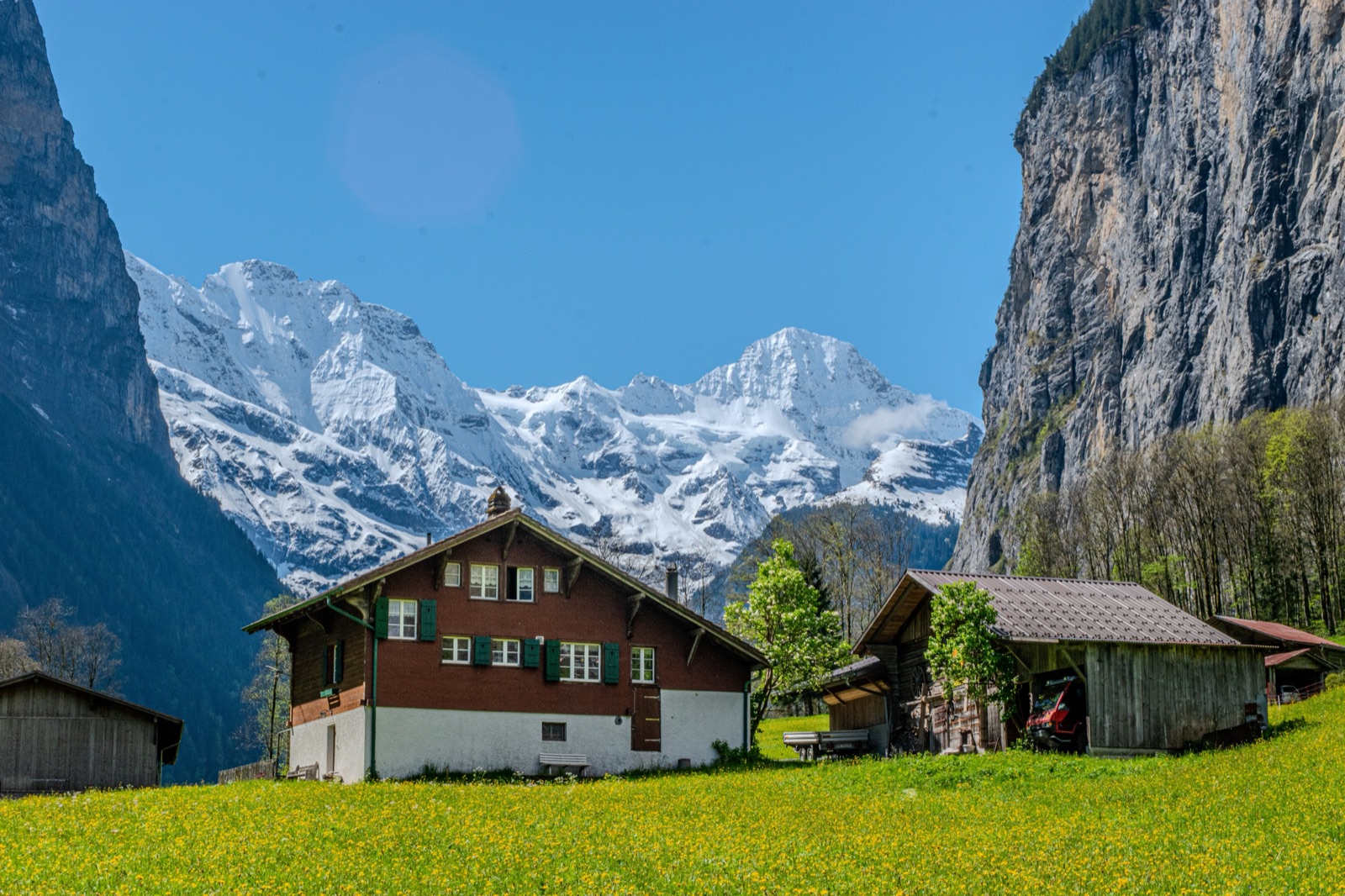
Beyond Lauterbrunnen, Wengen and Mürren, the valley has three smaller villages that most visitors never see. Gimmelwald is a car-free farming village of around 100 people at 1,367 m on the terrace below Mürren, reached by the Schilthorn cableway. Isenfluh, at around 1,024 m above the entrance to the valley, has a tiny cable car up to Sulwald (1,520 m) and a monster-scooter run back down. Stechelberg, at the end of the valley road, is the base of the world’s steepest cableway and the gateway to the upper valley’s walks, campsites and the candlelit Obersteinberg inn. All three belong to the municipality of Lauterbrunnen, and each is an easy half-day from the main village.
This guide explains how to reach each village, what there is to see and do, where to eat and sleep, and how to fit them into a visit.
One municipality, six villages
The municipality of Lauterbrunnen unites Wengen, Mürren, Lauterbrunnen, Gimmelwald and Stechelberg, and the formerly independent municipality of Isenfluh joined in 1973. Lauterbrunnen Tourism says all six villages keep their own identity, traditions and history while sharing municipal tasks.
| Village | Height | How to get there from Lauterbrunnen | Character |
|---|---|---|---|
| Gimmelwald | 1,367 m | Bus to Stechelberg, then the Schilthorn cableway | Car-free farming village |
| Isenfluh | Around 1,024 m | By road up the side of the valley | Quiet terrace village |
| Sulwald | 1,520 m | Cable car from Isenfluh | Alpine pasture and viewpoint |
| Stechelberg | Head of the valley | PostBus route 141 or the valley path | Gateway to the upper valley |
A little history
The valley’s villages are old. Lauterbrunnen was first mentioned, as in claro fonte, in a letter of 1240, and in the 14th century the Walser village of Lauterbrunnen was, in Lauterbrunnen Tourism’s words, the main centre of the Lötschern settlements in the Oberland, founded by settlers from the Lötschental. Gimmelwald, too, began as a Walser settlement, and Lauterbrunnen Tourism traces the valley’s rich store of legends to those settlers and the Alemanni before them; the Legend Trail at Stechelberg tells some of them.
Tourism came later, drawn first by the waterfalls rather than the peaks. Goethe visited in 1779 and wrote his poem about the Staubbach, and the first and second Trümmelbach falls were opened to the public in 1886, which brought day visitors up the valley towards Stechelberg. Switzerland Tourism adds that the valley captivated the 19-year-old J.R.R. Tolkien on a walk through the Swiss Alps in 1911.
Gimmelwald
What it is
Mürren Tourism describes Gimmelwald as a very unspoilt mountain farming village of around 100 inhabitants, where there are more cows than people. Its chalets are hung with flowers in front of the Jungfrau massif, and the sound of cowbells is usually the only noise. Switzerland Tourism adds that its townscape is protected: the former Walser settlement at 1,367 m is in the Inventory of Swiss Heritage Sites, with its old ornate wooden houses preserved.
Getting there
- By cableway. The Schilthorn cableway from Stechelberg stops at Gimmelwald on its way to Mürren. Its gradient of 159.4% makes it, in its operator’s words, the steepest cableway in the world, and on the way up it passes close to the Mürrenbach falls. It runs all year, apart from short overhauls in spring and autumn (in 2026, from 19 to 30 October, with a replacement bus via Mürren).
- From Mürren on foot. Gimmelwald lies below Mürren, and the walk down is short; ride the cableway back up.
- On the via ferrata. For experienced, equipped climbers, the Mürren–Gimmelwald via ferrata is the dramatic way in: 2.2 km along the cliffs, graded K3, open 1 June to 31 October.
- In winter on snowshoes. The Gimmelen Trail from Mürren to Gimmelwald is 5 km, about 2 hours 30 minutes, with 200 m up and 480 m down, a snowshoe route that Switzerland Tourism rates as difficult.
What to do
- The village walk. Switzerland Tourism describes a village tour past traditional chalets, old barns and farm animals, with stations on the village’s history. You can buy fresh milk and meat products directly from the farmers.
- The Sefinental. The heart of Gimmelwald’s walking: a hike of around 10 km into the Sefinental leads to the Chilchbalm, a wide basin below the north face of the Gspaltenhorn, surrounded by rock walls and waterfalls. It suits experienced families, with a fire pit by the stream for a break. Fit walkers can continue to the Obersteinberg inn or the Rotstock hut.
- The climbing garden. On the limestone walls near the village, over 70 routes graded 5c to 8c in two sectors make this one of the most challenging climbing areas in the region. It is about 50 minutes on foot from Gimmelwald, faces south and is used mainly from May to October.
- For children. There is a playground at the cable car station.
Where to eat and stay
Guests are catered for at the Mountain Hostel and the Pension Gimmelwald. The Mountain Hostel, which describes itself as simple and rustic, has 50 beds and a terrace with the valley at your feet; it suits walkers and travellers on a budget. Overnight guests in Gimmelwald get a guest card with free entry to the indoor pool and ice rink at the Alpine Sports Centre in Mürren, and from four nights a holiday pass with discounts on the mountain railways.
Who will love it
Walkers, climbers, anyone after silence and a working farm village. It is not for those who want shops, nightlife or many restaurants; for those, stay in Mürren or Lauterbrunnen and visit for a few hours.
Isenfluh and Sulwald
What it is
On a terrace above the lower Lauterbrunnen valley, Isenfluh lies at around 1,024 m. Lauterbrunnen Tourism describes it as peaceful and unspoilt, away from the main tourist crowds, with an impressive view of the Eiger, Mönch and Jungfrau. It became part of the municipality of Lauterbrunnen in 1973.
Above it, Sulwald, at 1,520 m, is reached on foot or by the small cable car.
The cable car
The nostalgic Isenfluh–Sulwald cable car has run since 1975 and, in the tourist board’s words, can carry eight people or a cow. It is an experience in itself and a reminder of traditional mountain life.
The monster scooters
The highlight of a summer visit is riding a monster scooter, a sturdy off-road scooter, from Sulwald back down to Isenfluh. The details published by the lift company:
- Route: Sulwald to Isenfluh.
- Distance: 4 km, with 400 m of descent.
- Difficulty: easy.
- Time: about 20 minutes of riding on a well-maintained forest track, and about 1 hour in all including the cable car.
- Season: June to October.
- Hire: at the valley station in Isenfluh.
Stop on the way at the Sulsbach waterfall. Lauterbrunnen Tourism’s FAQ lists the Trotti bikes from Sulwald to Isenfluh among the valley’s top activities.
In winter: the Sulwald sledge run
In winter the same cable car takes you and your sledge up to Sulwald. After a break at the Sulwald-Stübli, a 4-kilometre sledge run leads back through the winter landscape to Isenfluh, and in good conditions on down to Lauterbrunnen. It is one of the closest sledge runs to the main village; our guide to Lauterbrunnen in winter lists the others.
Getting there
Isenfluh is reached by a mountain road from the valley, on the slope above the entrance to the Lauterbrunnen valley. Check public transport connections in the SBB Mobile app before you go; if you are driving, Isenfluh is one of the villages in the municipality you can reach by car.
Stechelberg
What it is
Stechelberg is the last village on the valley road, where the floor of the valley begins to narrow towards the Hintere Lauterbrunnental, part of the Swiss Alps Jungfrau-Aletsch UNESCO World Heritage Site. It is greener and quieter than Lauterbrunnen, with campsites, a few hotels and holiday flats.
Getting there
- By bus. PostBus route 141 runs from Lauterbrunnen station along the valley to Stechelberg, stopping at the Trümmelbach falls and the Schilthornbahn station. The tourist board recommends buying tickets before boarding because the buses are often very full; in winter a free shuttle on route 143 also runs.
- On foot. The valley path from Lauterbrunnen to Stechelberg is flat, mostly suitable for prams and 2–3 hours long, passing the Staubbach falls and ending near the Mürrenbach falls.
- By car. There is a car park at the Schilthornbahn station, with a pre-payment ticket for 7, 14 or 30 consecutive days; parking here and in Lauterbrunnen is limited at busy times.
What to do
- Ride the Schilthorn cableway to Gimmelwald, Mürren, Birg and the Schilthorn at 2,970 m. A return from Stechelberg to the summit costs CHF 115 for an adult.
- The Trümmelbach falls are just down the road, ten waterfalls inside the mountain; Camping Breithorn says they are a 5-minute walk from the site.
- The Legend Trail leads from the hamlet of Sandbach into the back of the valley near Rütti: 3.9 km, about 70 minutes, with six posts on the legends of the valley.
- The Oberhornsee. Lauterbrunnen Tourism’s World Heritage walk climbs from Stechelberg through woodland and alpine terrain to this mountain lake below the north faces of the Grosshorn and Mittaghorn.
- Obersteinberg. The mountain inn with candlelight, paraffin lamps and its own cheese dairy is reached only on foot, about two hours from Stechelberg. Book by phone.
Where to stay
- Camping Breithorn, at Sandbach, right by the bus route.
- Camping Rütti, at the end of the valley beside a mountain stream at 920 m.
- Hotel Stechelberg, with a large garden restaurant at the gateway to the upper valley.
- Obersteinberg, for a night without electricity.
Wild camping is not permitted anywhere around Lauterbrunnen, including the upper valley above the tree line.
And the two big villages
The small villages make most sense alongside the two big ones on the terraces.
- Mürren, on the western terrace at about 1,650 m, is car-free, with hotels, restaurants and shops, the Allmendhubel funicular and the cableway on to the Schilthorn. Gimmelwald is its quiet neighbour, a short way below.
- Wengen, on the eastern terrace at 1,274 m, is car-free too, 12 minutes from Lauterbrunnen by cog railway, on the line to Kleine Scheidegg and the Jungfraujoch.
Both are covered in detail in our guide to Mürren, Wengen and the Schilthorn, and our guide to where to stay in Lauterbrunnen compares all six villages as bases.
Which village should you visit?
- Only time for one: Gimmelwald, combined with Mürren on the same cableway.
- With children: Isenfluh for the monster scooters (for older children), or Stechelberg for the Legend Trail and the campsites.
- For a serious walk: Stechelberg, for Obersteinberg and the Oberhornsee, or Gimmelwald for the Sefinental.
- In winter: Isenfluh for the Sulwald sledge run.
- With a car: Isenfluh or Stechelberg, since Gimmelwald is car-free.
Tickets and passes
The cableways are the main cost of visiting the small villages.
- Swiss Travel Pass: free travel to Mürren and discounts on the mountain railways.
- Half Fare Card: reduced fares on the Schilthorn cableway, as with the Swiss Travel Pass, the GA travelcard and Eurail or Interrail passes.
- Guest card: given by your accommodation in the valley, with local discounts; in Mürren and Gimmelwald it includes free entry to the indoor pool and ice rink at the Alpine Sports Centre.
- Buses: buy tickets for route 141 at the machine at Lauterbrunnen station or in the SBB Mobile app before you board.
Seeing the villages from the air
Tandem paragliding flights take off above Mürren, in front of the Eiger, Mönch and Jungfrau, and fly for up to 20 minutes over the valley, with Gimmelwald and the cliffs of the upper valley below you. It is the best way to understand how the villages sit on their terraces. Flights are listed on our tours page.
Combining the three in a visit
A day on the Stechelberg side
- Walk or take the bus from Lauterbrunnen to the Trümmelbach falls.
- Continue to Stechelberg and ride the cableway to Gimmelwald.
- Walk the village, then ride on to Mürren for lunch and return via Grütschalp to Lauterbrunnen.
A half-day at Isenfluh
- Go up to Isenfluh, take the cable car to Sulwald and enjoy the view.
- Ride the monster scooter down in summer, or the sledge run in winter.
- Back to Lauterbrunnen in time for an afternoon on the valley floor.
Two days for walkers
- Day one: Stechelberg to Obersteinberg, a night at the inn.
- Day two: over to Mürren, about four hours, and down via Gimmelwald.
Our guide to Lauterbrunnen hikes has more routes, and our guide to Mürren, Wengen and the Schilthorn covers the bigger villages.
Practical tips
- Cash. Small villages and mountain inns may not take cards. Mürren, the nearest place for Gimmelwald, has only one cash machine.
- Shops. Choice is very limited in the small villages; stock up in Lauterbrunnen or Mürren before you go.
- Water. Tap water and fountain water are safe unless marked otherwise.
- Respect. These are working farm villages. Keep to the paths across meadows, close gates, and give cows space: the tourist board advises staying calm, not walking straight at them and speaking to them if you have to pass close.
- Drones. Not permitted anywhere in the valley.
- Lift overhauls. In late October and November some lifts close for maintenance; check the operators’ pages before relying on a cableway.
When to visit
- June to October is the season for the Sulwald scooters, the via ferrata and the high walks.
- September brings the cattle down from the mountain pastures, with dates announced shortly beforehand.
- Winter suits the Sulwald sledge run and the snowshoe trail to Gimmelwald; the upper valley walks are under snow.
Frequently asked questions
How do I get to Gimmelwald from Lauterbrunnen?
Take bus 141 to the Schilthornbahn station at Stechelberg and the cableway up to Gimmelwald, or go up to Mürren via Grütschalp and walk down.
Is Gimmelwald car-free?
Yes. It is reached by the Schilthorn cableway or on foot.
How many people live in Gimmelwald?
Around 100, according to Mürren Tourism.
What is there to do in Isenfluh?
Ride the cable car to Sulwald for the view, and in summer the monster scooters back down, 4 km with 400 m of descent. In winter there is a 4-kilometre sledge run.
Is Stechelberg worth visiting?
Yes, as the base for the Schilthorn cableway, the Trümmelbach falls nearby and the walks into the upper valley. It is also a quieter place to stay or camp than Lauterbrunnen.
Can I stay overnight in Gimmelwald?
Yes, at the Mountain Hostel, which has 50 beds, or the Pension Gimmelwald.